
For UK golf clubs
Health & safety compliance that completes itself.
ClubSentinel is web-based health and safety software built for UK golf clubs, made by SentinelHQ Limited in England.
It's not one logbook. It's a dozen, in a dozen different places.
Greenkeeping's records are in the shed, the kitchen's are by the pass, the cellar checks are on a clipboard and the training certs are in someone's inbox. You're accountable for all of it, and on any given day, nobody's quite sure what's current. (The greenkeeper writing up the day's checks from memory at 6pm is just the part you can see.)
The cost of inaction.
An environmental health investigation that finds a material breach can lead to improvement or prohibition notices, and to prosecution, where fines are set against turnover. In February 2026 St Helens Council prosecuted a golf club after an apprentice was injured in an excavator bucket: £5,000 fine plus a £2,000 victim surcharge.
An insurer declines
A claim following an accident turns on whether your risk assessments and equipment records were current at the time, not whether they exist now.
An inspection escalates
Missing evidence turns a conversation into an investigation. Fines for health & safety offences are set against turnover, and the guidelines reach well beyond what most clubs assume.
A committee is exposed
Duties sit with the people running the club. ‘We thought it was covered’ has never been a defence.
None of this is about paperwork. It's about being able to show, on any given day, that the club did what it said it did.
Case study
“Managing health and safety compliance across a busy golf club is no small task. Like many clubs, we were struggling with documentation spread across multiple areas, paper records, certificates, COSHH product registers, equipment checks, all held in different places with no single system joining them together.
We had tried an online solution previously, but it was cumbersome to use and offered little in the way of automated reminders or reporting. Staff were left to remember what needed doing and when, which simply isn't sustainable.
The issue was raised at a committee meeting, and Kevin, who manages our website, social media and club technology, proposed building something purpose-built for the club. ClubSentinel was developed over approximately three months, with input from all heads of department throughout the process to make sure it reflected how we actually work.
We have now been live on the system for several months. It handles everything we needed and more. Heads of department receive automatic notifications when a document or task is due, so nothing gets missed. Incidents can be dictated and analysed using AI, which saves considerable time compared to manual reporting. Our head greenkeeper uses a dedicated greens report module that lets them walk the course and record observations by voice, no paperwork, no delay. Every piece of equipment and club asset carries a QR code. Staff scan it on the spot to view the full service history, log an inspection or raise a fault, no going back to the office to update a spreadsheet.
There was nothing like this available specifically for the golf industry. For any club that takes health and safety compliance seriously, I would strongly recommend ClubSentinel.”
 Ray TattersChairman at Wearside Golf Club
Interactive demo
See it in action, try it yourself.
Walk through a real Monday morning at the club, the whole club on one screen, then an incident logged by voice, an out-of-date document signed off, a walk round the course, a machine checked by scanning the QR code on it, a gas safety certificate found in seconds when the insurer asks, and a new chemical added to the register just by photographing the label.
Compliance walkthrough
A Monday morning at the club, the AI showing you what’s overdue, an incident logged by voice, a walk round the course recorded as it happens, a machine checked by scanning it, and the score moving each time you clear something.
Try the walkthrough →No sign-up, nothing is sent, and every name, date and figure is fictional.
Speak it or upload it
Two ways in. One set of records.
Not everything starts as a voice note. Hand ClubSentinel the paperwork you already have. It reads the documents and builds the records, then answers your questions from them.
Upload it
The AI reads your documents.
Drop in a safety data sheet, a certificate or a policy PDF and ClubSentinel reads the details straight off it, filling in your COSHH register, your training records and your documents from what you already hold.
Ask it
Answers from your own records.
Ask in plain words and get a straight answer, drawn only from your club's own records, no digging through folders or inboxes.
And it joins the dots. One voice note is read by the AI, which decides what the club actually needs. A spilled chemical adds the substance to your COSHH register. A cracked bracket raises a maintenance job. A reportable injury flags itself against RIDDOR 2013. Sometimes nothing needs raising, and it says so. Every record it creates carries the same reference.
Every duty, covered
One less thing to worry about. Then another. Then another.
Fifteen modules, grouped the way the club already works: Operations, Records and Audit. One system, one score, everything connected.
Greens Report ★ Featured
Daily greenkeeping record, spoken from the course.
Assets
Scan any machine for history and checks.
Maintenance
Faults raised the moment they are spotted.
Inspections
Course, clubhouse and kitchen walks, recorded and dated.
Scheduled Checks
Recurring checks arrive on schedule.
Training
Certificates flagged before they lapse.
Safe Working
Method statements and risk assessments.
Documents
Policies, certificates and records in one current place.
Incidents & RIDDOR
Near-misses logged and RIDDOR checked by voice.
Reports
Evidence packs build themselves, ready to hand over.
Audits
Findings file against the right standard.
Templates
Club checks built once, reused often.
Compliance Register
One register for every duty.
COSHH Register
Every chemical read from the SDS.
Safeguarding
Concerns documented, thresholds checked.

It all lands here
Everything from the day, in one live score.
Records go in by voice at the point of work, and land on one dashboard that updates the moment a record closes. One number for where the club stands today.
Your score is 84. Training is your lowest area at 71%. Renew the 3 expiring tickets this week.
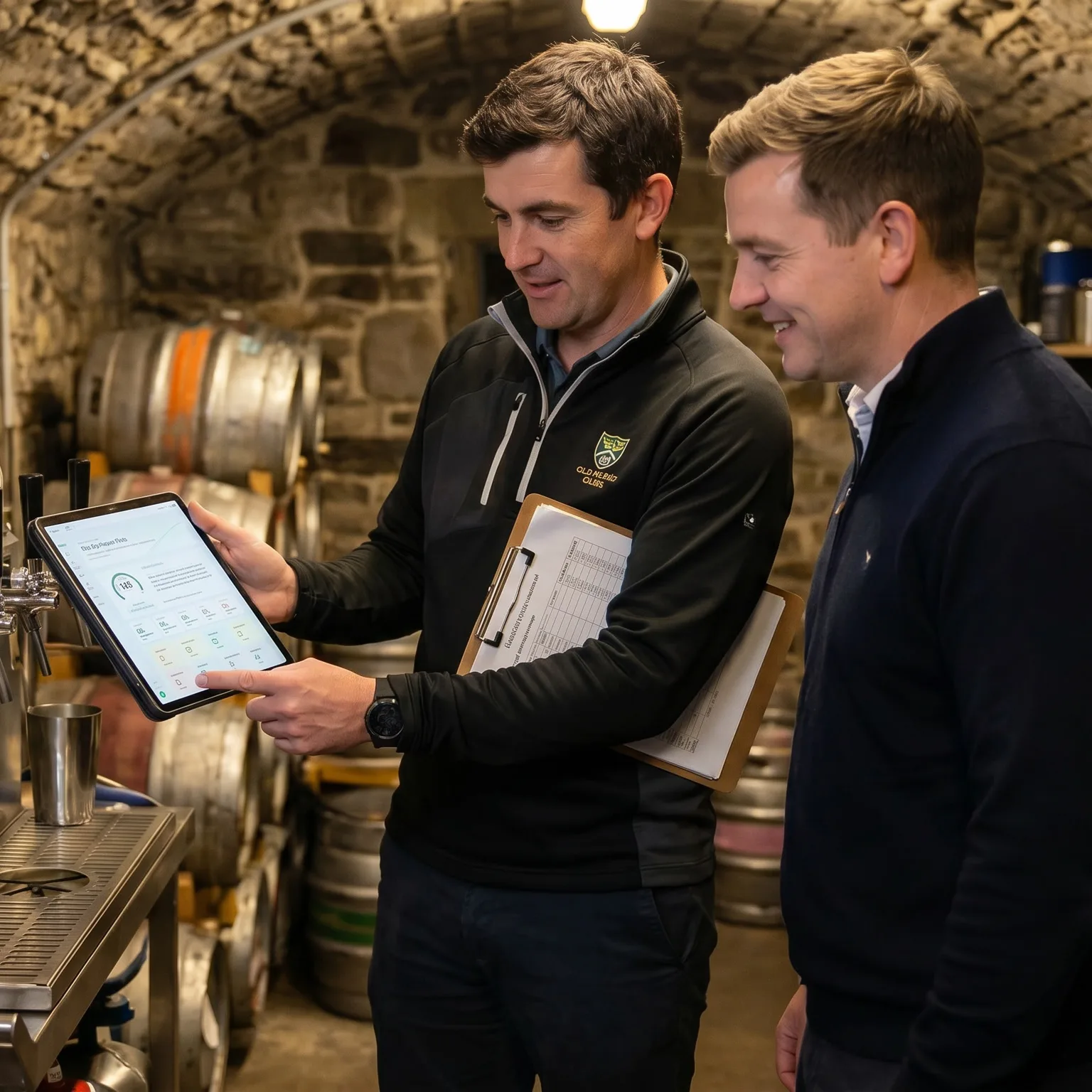
Inspection ready
The morning the inspection stops being scary.
Walk in with every check evidenced, every action dated, nothing left to dig for, whether it's environmental health, the insurer or the committee.
Inspection evidence pack
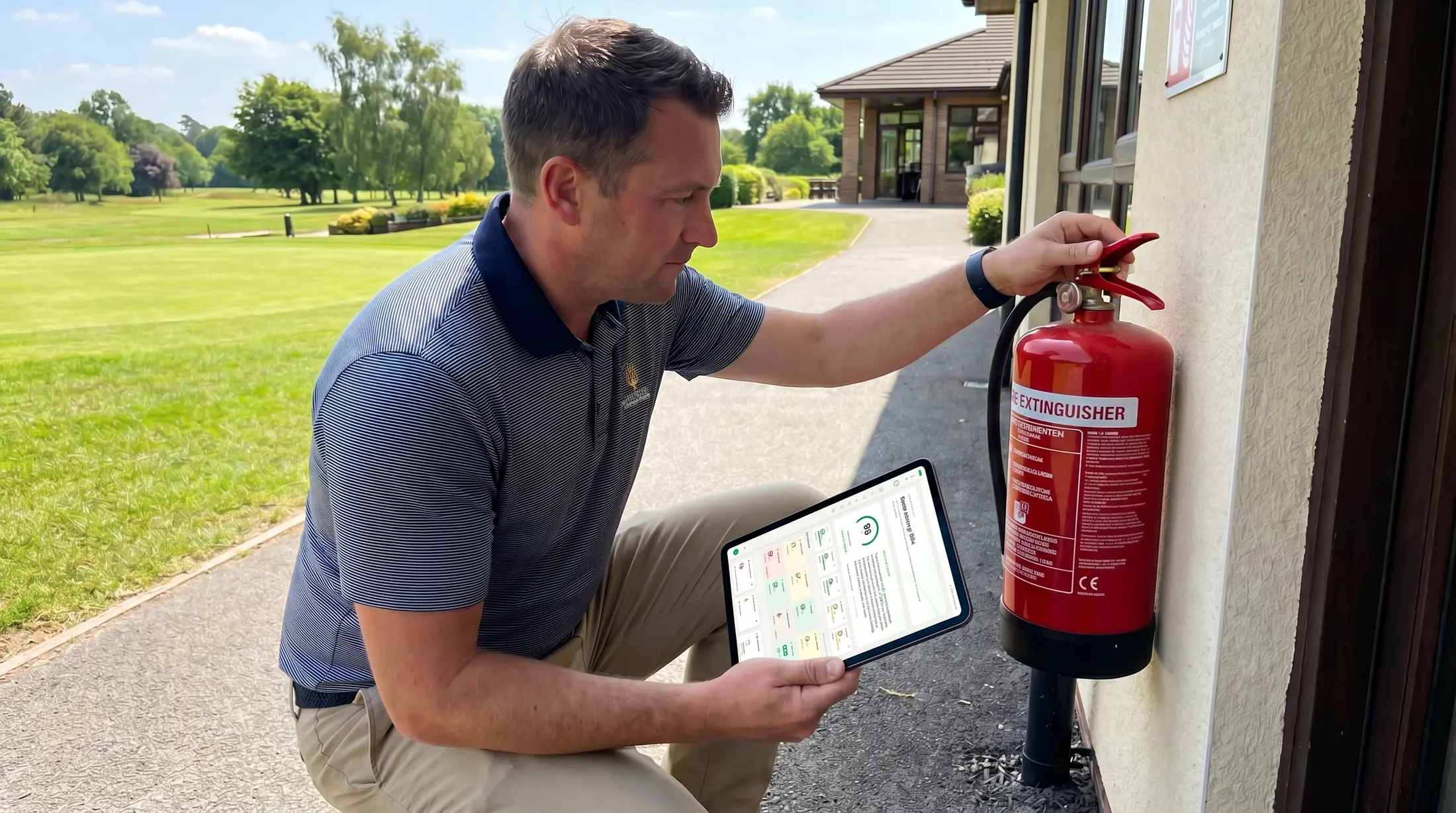
After setup
The hard part's already done. Keeping it up is the easy bit.
The AI does the heavy lifting at the start, reading your documents and building the records, so you never face a blank system. After that it's a few seconds a day: speak the check, confirm the prompt, done. The score stays current on its own.
Questions clubs ask
The honest answers, before you ask.
How soon can we start using it?
The same day. Your club is set up before the demo call ends and you can log an incident, run an inspection or add a document straight away. There is no waiting period and no implementation phase.
Once you are up and running, one of our team books a screen share with you for up to two hours and takes you through the whole system at whatever pace suits. Bring whoever you want on the call: the secretary, the head greenkeeper, whoever looks after health and safety. You do not have to wait for that session to start using it.
What actually is ClubSentinel?
ClubSentinel is web-based health and safety software built for UK golf clubs, made by SentinelHQ Limited in England.
It is a single place to run your club's health & safety record-keeping. Instead of records scattered across the greenkeeping shed, the clubhouse, the kitchen, the cellar and the office, everything lives in one system, captured by voice or by uploading documents you already have, structured automatically by AI, and rolled up into one live Records Score, a clear, honest view of your own records you can share with your committee at any time. Records connect themselves. When someone logs an incident by voice, the AI reads what happened and creates whatever follows from it: a COSHH register entry, a maintenance job, a RIDDOR assessment, or nothing at all if nothing is needed. You get told what was created, and each record links back to the incident it came from.
How does the Records Score actually work?
ClubSentinel is a record-keeping system, not an auditor. The score answers one question: is what you've recorded up to date and in order? It's a single number from 0–100, weighted across eleven core areas. Each area scores its own percentage based on whether its records are current and complete, and contributes a different weight to the total:
- Incidents16%
- Maintenance12%
- Training12%
- Scheduled Checks10%
- Documents10%
- Inspections9%
- COSHH9%
- Safe Working7%
- Safeguarding6%
- Assets5%
- Audits4%
Incidents carries the heaviest weight, because unreported or unmanaged incidents carry the most risk. An area with no records at all scores 0% and still counts toward the total. It's not excluded just for being empty. A club can mark an area genuinely not applicable to them (with a required reason, recorded and shown on the dashboard) and that's the only thing that excludes an area from the weighting. The tiers are Excellent (90–100), Good (80–89), Developing (60–79) and Needs Improvement (0–59).
A “this week's focus” line tells you, in plain English, your lowest area and the single most useful thing to do next, e.g. “Training is your lowest at 71%. Three tickets expire within 30 days.”
Do I have to type everything in to get started?
No, that's the part most systems get wrong. You populate ClubSentinel from the documents you already have. Upload a safety data sheet and the AI reads it into your COSHH register; upload certs, policies and records and they're filed and dated automatically. The heavy lifting is at the start, and the AI does most of it. After that, keeping it current is a few seconds a day, speak what happened, and the record's written.
We already work with a health and safety consultant. Does this replace them?
Not necessarily. A consultant writes your policies and risk assessments. ClubSentinel is where they live once they are written, and it is what proves they are being followed day to day. Upload what your consultant produces and it is filed, dated and put in front of the right person for sign off. Plenty of clubs keep both. What ClubSentinel replaces is the annual scramble to find everything again.
Is it built specifically for golf clubs?
Yes. The modules, the language and the way it all works are built around how clubs actually run, the greenkeeping shed, the course, the clubhouse kitchen, the bar cellar, not generic compliance software bent to fit. The Greens Report module in particular has no equivalent in general H&S tools.
What is the Greens Report?
A monthly course report, built from short voice notes. The head greenkeeper records a note whenever there is something to say about the course. At the end of the month the AI writes the notes up as a report, the greenkeeper checks it and presses Send, and it is emailed to the club secretary, ready for the committee meeting. Nobody has to write it up from memory the night before.
Do we have to use QR codes?
No. QR codes are there so staff can scan a machine or a check point and go straight to its history without walking back to the office. If you would rather people log in and pick from a list, everything works the same way. Nothing depends on them.
Do I need any technical knowledge to set it up?
No. If you can take a photo, send a voice note or upload a PDF, you can run it. Setup is included.
Can the whole team use it, including volunteers?
Yes. Unlimited staff accounts are included at no extra cost, so greenkeepers, bar staff, the club manager and committee members can all log and view what's relevant to them. There's no per-user fee.
Does it cover our health & safety obligations?
ClubSentinel is built around UK health & safety duties, risk assessments, COSHH, RIDDOR reporting, training records, equipment checks and the evidence trail an inspector or insurer expects. It helps you stay inspection-ready and prove what you've done, though it doesn't replace your own legal responsibility for compliance.
Is our data secure?
Yes. Your records are held on secure servers in the UK, scrambled both while they are being sent and while they are stored, and only the people at your club you have given access to can see them. You can print or download your records whenever you want, and if you ever leave we hand you a full copy of everything.
Is there a contract or lock-in?
No long contract. It is £199 a month. The first payment is by card so your club starts straight away. After that you can keep paying by card, or ask us to invoice you. Annual invoicing is available on request.
What does it cost?
£199 a month for one club, with every module, the live Records Score, unlimited staff accounts and setup included. No tiers, no per-user fees, no surprises at renewal. Pay your first month by card and your club is set up straight away. After that you can keep paying by card, or ask us to invoice you. Annual invoicing is available on request: email hello@sentinelhq.co.uk.
Can we pay by invoice instead of card?
Yes, after your first payment. Pay the first month by card so your club is set up straight away, then ask us and we will invoice you from then on at £199 a month. Annual invoicing is available on request. Invoices are payable within 30 days and purchase order numbers are fine. If you would rather talk to us before paying anything, request an invoice and we will be in touch.
What happens if we get stuck?
Email us and you will normally hear back the same working day. You get an answer from someone who knows how golf clubs run, not a ticket number in a queue. If something is stopping you working, say so in the subject line and it goes to the front.
Still have a question? hello@sentinelhq.co.uk
Simple, one-club pricing
Everything included. One flat price per club.
What it replaces
- A retained H&S consultancy contract, typically several thousand a year, and the records are still yours to keep.
- A consultant's day rate for a single audit.
£199 a month is £2,388 a year. One club, every module, unlimited staff.
One club · all modules · unlimited staff accounts · setup included.
Annual invoicing available on request.
- All 15 modules & the live H&S score
- Voice capture on any device
- Live compliance dashboard
- Unlimited staff & data export
Pay your first month by card and your club is set up straight away. After that you can keep paying by card, or ask us to invoice you. Want to talk to us first?
Easy enough to use today. Ready for the day it counts.
£199 a month · pay by card or invoice · Annual invoicing available on request.